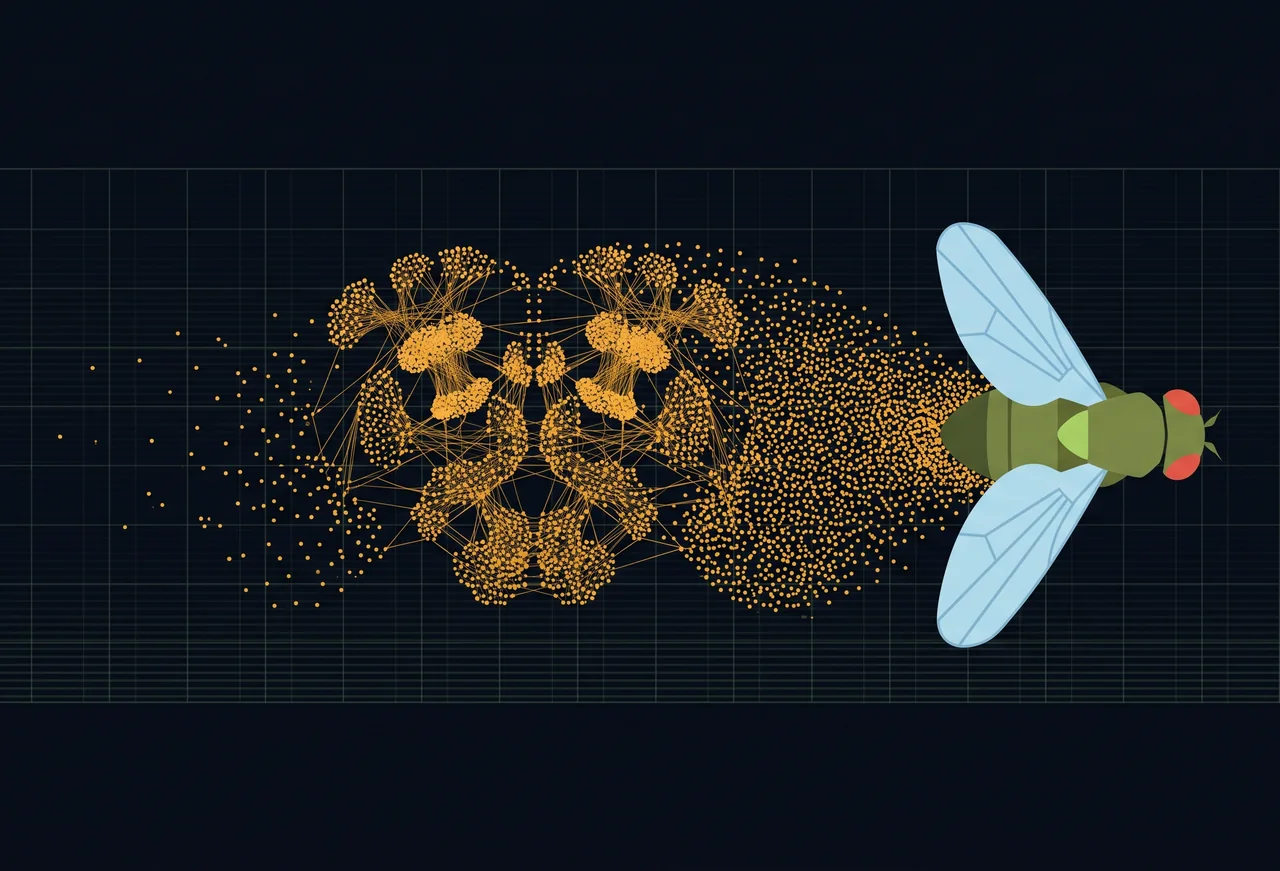
A fly brain runs the treasury. You can redo every decision.
FlyPool simulates a real fruit-fly brain: 138,639 neurons, mapped one by one under an
electron microscope. When its sugar neurons fire, the treasury buys the
token. When its escape neurons fire, tokens are burned. Nobody presses
the button.
A decision that cannot be replayed is a decision that was invented.
Every decision ships with what you need to replay it on your own machine: same brain,
same seed, same spikes, same action. If you get a different answer, the decision was
false.
139,255 neurons, ~54.5 million synapses. The map this project runs on was traced
under an electron microscope, not drawn.
01 · In plain terms
Four steps, from microscopy to the chain
01
A mapped brain
The FlyWire connectome catalogues the neurons of an adult fly brain and their
connections, reconstructed from thousands of electron-microscopy sections. We
simulate 138,639 neurons and
15,091,983 connections, 40 % of them inhibitory.
02
A published model
Each neuron is integrated using the model of Shiu et al. (Nature, 2024),
whose constants come from published electrophysiological measurements. Our
implementation is checked against Brian2, the reference simulator:
strict spike-for-spike equality, neuron by neuron.
03
A fly that lives
It moves through an arena where sugar sources appear and run dry. It only eats if
it reaches them. A visual threat looms over it and it flees. What
it feels modulates what it perceives.
04
A decision you can contest
At regular intervals, a deterministic epoch measures one circuit and derives a
bounded action from it. The seed is committed on-chain before the
simulation runs: rerolling until the desired outcome appears is impossible.
The two loops are never mixed, and the instrument always says which one you are
looking at.
02 · What the brain does to the token
Three reflexes, wired to three actions
The contract holds two piles: ETH (the treasury) and
FLYPOOL (the reserve). Every 15 minutes during the first hour after launch, then every 30 minutes, the brain is measured. The
circuit that fires decides what happens to one of those piles, and how much, within
limits nobody can lift overnight.
Sugar → Buyback
It tastes sugar, it buys.
ETH treasury → Uniswap pool
→ FLYPOOL out of the pool
A slice of the treasury's ETH buys FLYPOOL on the pool, at the pool's own price. The
tokens leave the pool, the pool holds a little more ETH and a little less FLYPOOL, so
the price edges up. There is no seller on the other side: only the pool.
Trigger
Sugar-sensing neurons driving motor neuron MN9, the validated circuit
Size
Set by the clock: the whole treasury is spent over the 2 days after launch, each buyback uses the time since the last one ÷ the time left. Never more than 1 % of the pool's ETH at once
A slice of the contract's FLYPOOL is sent to the dead address, a wallet nobody holds a
key to. Those tokens can never move again: the supply that can circulate shrinks
for good.
Trigger
The giant-fibre escape circuit, provisional, so a quarter of the cap
Size
Up to 0.025 % of the reserve; at most 1 % of supply burned per week
The decision is written on-chain with its proof, like any other, and deliberately
moves nothing. It shows the brain was measured and chose to stay put.
Trigger
The grooming circuit
Size
None
Calm → Nothing
A quiet brain sends nothing.
Below 5 % of a full response → no transaction
Background noise is not a decision. If the circuit fires at less than 5 % of a full
response, no transaction is sent at all. Many hours look like this, and that is
normal.
Nobody picks the moment, the size or the direction. The spikes do.
03 · Try a reading
Pick a firing rate. The action changes.
This runs the published rule, the same one the engine applies: the firing rate is
divided by 100 Hz to give an activity; under 5 % nothing happens; above that, the size
grows with the activity until it hits its cap.
Buyback
Activity
40 % of a full response
Size
set by the clock, not by the activity
In practice
Buys with the slice the clock allows: the treasury is spent evenly over 2 days
An illustration of the rule, not a live quote. A real epoch publishes the measured rate
and the exact size in its record, and the contract recomputes the amount from its own
balances.
04 · Limits written in the contract
Even a buggy brain cannot go faster than the rules
The engine proposes, the contract checks. Every limit below is enforced on-chain, and
amounts are recomputed from the contract's own balances and the pool's reserves: a
number sent from outside is never trusted.
2 days
The ETH treasury is spent evenly over the 2 days after the first decision, never faster.
15 → 30 min
Minimum wait between two epochs: 15 min in the first hour after launch, then 30 min.
1 % of the pool
Largest buyback, measured against the pool's ETH.
1 % a week
Circuit breaker on everything sent to the dead address.
0.1 %
Maximum share of the FLYPOOL reserve one epoch can burn; limits change only after a 2-day public delay.
Seed first
Committed on-chain before the brain runs, checked by the contract.
Buyback, for real. 0.00144 ETH from the treasury bought 47,833 test tokens on
the Uniswap V2 pool. See the transaction
Burn, for real. 25,000 test tokens sent to 0x…dEaD; the replay of that epoch
conforms. See the transaction
A project can claim it runs a brain while giving you nothing to check. Here is what we
measured on the full connectome, and what we failed to establish. Both columns matter
equally.
Feeding circuit, sugar-sensing gustatory neurons onto motor neuron MN9, which drives
proboscis extension. Measured over 1,000 ms of biological time.
Stimulation
MN9 firing rate
Share of brain active
0 Hz
0.0 Hz
0.00 %
20 Hz
10.0 Hz
0.21 %
40 Hz
59.5 Hz
0.39 %
60 Hz
76.0 Hz
0.39 %
100 Hz (outside the domain)
53.5 Hz
6.39 %
That last row is the reason every circuit declares an
operating range that the code refuses to exceed. Past 60 Hz the
response stops being monotonic and activity multiplies sixteenfold. A model is only
trustworthy in the regime where its behaviour has been checked. We would rather publish
that boundary than let anyone believe it does not exist.
What we verified, and what we did not.
Claim
Status
What establishes it
The engine reproduces the published model
Verified
Strict spike equality with Brian2, four networks
A decision replays identically
Verified
Spike, protocol and decision digests all reproduced
A falsified record is rejected
Verified
Four tampering attempts tested, all detected
The escape circuit recruits the giant fiber
Verified
0 → 78 → 105 → 137 → 178 Hz, under 1 % of the brain active
Actions execute on-chain
Testnet
On Robinhood Chain testnet, a
real buyback:
treasury ETH bought 47,833 test tokens on the Uniswap V2 pool; and a
real burn:
25,000 test tokens sent to the dead address. Freeze verified on a local chain. Nothing on
mainnet
The paper's quantitative calibration
Not reproduced
80 % reported, 50 % measured, cause identified and recorded
The grooming command neuron responds
Disproved
DNg12 fires at no frequency; readout moved to DNg84
The foraging circuit is usable
Disproved
8 % of the brain active from 10 Hz; allocation stays unreachable
The contracts are audited
No
36 tests including fuzzing and invariants, no external audit
Commercial use of the data is permitted
Unverified
Reference code licence: MIT. FlyWire data: not verified
What FlyPool is not
It is not a living fly. The connectome is the map of one single
individual, female, adult, taken post-mortem. The model covers the central
brain and excludes the ventral nerve cord. It has neither plasticity nor learning:
the fly does not improve.
These are not emotions. They are persistent internal states
documented in the literature, displayed under their scientific names, with their
citations. "Defensive arousal", not "fear".
The mapping from neural activity to token action is a
convention we chose. Biology determines the input, not the financial
decision. Not conflating the two is the only thing we ask.
07 · Nothing here asks to be believed
The means by which you can catch us out
The connectome snapshot is frozen and identified by its digest, checked on every load.
The engine code is identified by its commit. Each epoch's seed is committed on-chain
before the computation and revealed afterwards: picking the seed that
yields the desired action is impossible, and the contract verifies this itself.
A single command replays any published decision on your own machine, from its archived
record. It recomputes the spike trains and compares the digests. If they differ, the
decision was falsified, and you needed no one's word for it.
We are not asking you to believe us. We are giving you what you need to redo the
computation.
Nothing here is ours to assert. Each line below is a published paper, with its DOI: the
connectome we run, the model we reproduce, and the measurements behind every internal
state we display. What is ours, the arena, the state constants, the
mapping from neural activity to an on-chain action, is named as such, in
the method.
The authors and institutions involved are not affiliated with this project, do not
support it and do not endorse it.
The sign of each connection, excitatory or inhibitory. Without it no simulation is possible.
Shiu et al.Model
A Drosophila computational brain model reveals sensorimotor processingNature 634:210-219 (2024)doi:10.1038/s41586-024-07763-9
The leaky integrate-and-fire model this engine reproduces, with no parameter tuned per circuit.
Gibson et al.States
Behavioral responses to a repetitive visual threat stimulus express a persistent state of defensive arousalCurrent Biology 25:1401-1415 (2015)doi:10.1016/j.cub.2015.03.058
Defensive arousal persists for minutes and accumulates with repetitions.